
BHAGWAT GEETA CLASS
SUN APR 19, 11 AM - 12:30 PM EDT
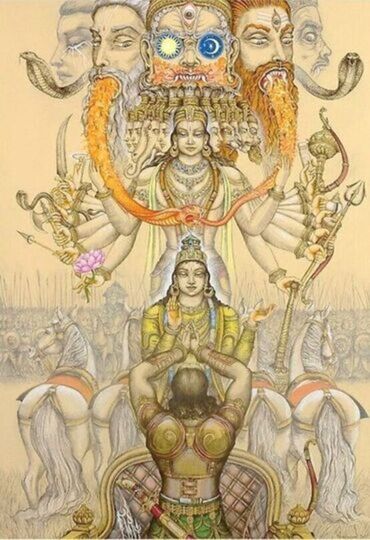
Bhagavad-gītā is a small, though very important, section of the vastly longer epic poem, the Mahābhārata. In the Mahābhārata, the great Battle of Kurukṣetra is about to commence. This battle (recounted in the course of several parvans, or large portions, of the Mahābhārata) will be fought over a period of eighteen days, the culmination of a years-long feud over sovereignty of a kingdom, between the five sons of Paṇḍu—the Pāṇḍavas—and their one-hundred cousins, the Kauravas. Duryodhana, leader of the Kaurava brothers, has rejected all conciliatory gestures by the Pāṇḍavas who, ever since childhood, had suffered numerous abuses by him.On the first day of the battle, prior to the first armed engagement, the Pāṇḍava warrior, Arjuna, and his charioteer, Krishna, hold an extended consultation. It is this dialogue, in which Krishna counsels Arjuna on focused engagement (yoga), that constitutes the Bhagavad-Gītā.
Each of the eighteen chapters of the Bhagavad-gīta has, traditionally, a Sanskrit title which includes the word yoga. First, the entire Gītā is about yoga, providing a wide-ranging comprehension of yoga’s principles and processes; and second, each of the eighteen chapters function as complete units, one chapter offering a particular approach to the over-all message of spiritual engagement (yoga). Each chapter is both analytical and synthetic in character—opening out the subject in careful scrutiny and drawing together apparently diffuse ideas into a unified (yoga) vision.
OBJECTIVE
Here we will overview the Bhagavad-Gītā chapter by chapter, both to gain a sense of the essential contours of the work, and to call attention to the varied ways in which yoga is represented throughout the work. As we will see, while the Gītā has a definite linear progression from Chapter 1 through Chapter 18, it is also a “song” (Gītā), complete with refrains and a rich, varied rhythm of expanding and heightening vision of cosmic order and consciousness, and of the hope and possibility for human individual and collective well-being.
Here we will study the Bhagavad-Gītā chapter by chapter, both to gain a sense of the essential contours of the work, and to call attention to the varied ways in which yoga is represented throughout the work. As we will see, while the Gītā has a definite linear progression from Chapter 1 through Chapter 18, it is also a “song” (Gītā), complete with refrains and a rich, varied rhythm of expanding and heightening vision of cosmic order and consciousness, and of the hope and possibility for human individual and collective well-being.
Online Offering
Joining information will be shared with you after you register.
Share this
CONTACT


 OfferingTree